The Framework That Shaped My Career
For years, Ravi Mehta’s “What’s Your Shape?” has been my most-used PM framework. Not the most-cited — that’s probably some variation of “jobs to be done.” But the most used, in three very concrete ways:
- Self-assessment. Where am I strong? Where do I need to grow? Mehta’s twelve competencies across four areas gave me a map for my own development.
- Explaining PM. When someone outside product asks “what does a PM actually do?”, I’ve pulled up Mehta’s radar chart. It’s the clearest articulation of the role I’ve found.
- Evaluating PMs. When I’m assessing someone on my team or interviewing a candidate, Mehta’s framework is my mental model. Where are they strong? Where are the gaps? Does their shape complement the team?
The framework maps twelve core competencies across four areas: Product Execution (feature specs, delivery, quality), Customer Insight (data fluency, voice of the customer, UX design), Product Strategy (business outcomes, vision, strategic impact), and Influencing People (stakeholder management, team leadership, managing up).
It’s brilliant. It’s also increasingly incomplete for the world we’re entering.
What Mehta Built — And Why It Worked
Before I redraw the map, I want to be clear about what Mehta got right. His framework worked because it did two things no other PM competency model had done:
First, it was specific. Not “be strategic” but twelve named competencies you could actually evaluate. Feature Specification. Voice of the Customer. Business Outcome Ownership. Each one was concrete enough to assess and develop.
Second, it was visual. The radar chart wasn’t just a presentation gimmick — it showed you your shape. You could see immediately where you were lopsided, where the gaps were, and where your shape diverged from your team’s needs. That visual clarity is what made it stick.
I’m keeping both of those principles. What I’m changing is what sits on the axes.
What AI Collapsed
Walk through Mehta’s twelve competencies in 2026 and something striking emerges: about a third of them are being automated or radically compressed.
Product Execution was three competencies:
- Feature Specification. Writing PRDs, user stories, acceptance criteria. AI drafts these in minutes now. The skill isn’t writing the spec anymore — it’s knowing whether the spec describes the right thing.
- Product Delivery. Sprint coordination, ticket management, status updates, cross-team orchestration. This is the heartland of coordination work, and it’s the most automatable PM activity that exists.
- Product Quality. QA processes, bug triage, quality bar enforcement. AI-assisted testing, automated code review, and AI-generated test suites are compressing this rapidly.
Customer Insight included one competency that’s shifting:
- Fluency with Data. Writing SQL queries, building dashboards, running analyses. AI does this faster and with fewer errors than most PMs ever could. The skill that survives isn’t running the analysis — it’s asking the right question and knowing when the numbers are lying to you.
That’s four of twelve competencies — the entire Product Execution area plus data fluency — getting compressed by AI. Not eliminated. But radically devalued as differentiators. The PM who built their career on writing detailed specs and running tight sprints is watching their core value proposition erode.
Meanwhile, the remaining eight competencies don’t just survive. They become more important. When building is cheap, deciding what to build and getting the organization aligned behind it becomes the entire game.
But eight competencies is still too many for a clean framework. Some of them naturally merge when the execution layer compresses. Here’s where it gets interesting.
Redrawing the Map
I’ve reorganized the surviving competencies — plus one entirely new one — into four axes. Each represents a competency domain that remains irreducibly human and increasingly valuable in the AI era.
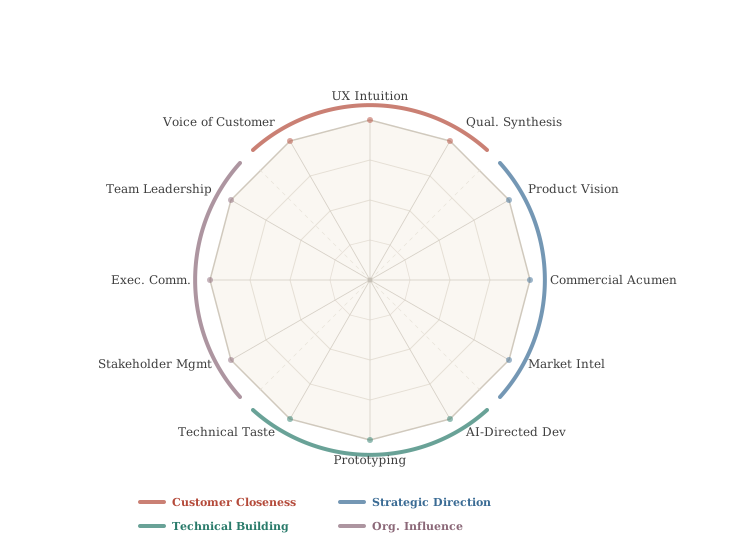
Customer Closeness
Absorbs from Mehta: Voice of the Customer, UX Design
This is proximity to the problem. Not “did you read the NPS report” but “have you watched someone struggle with this workflow?” Not “what did the survey say” but “what didn’t the customer say that you picked up on?”
AI can synthesize survey responses, cluster support tickets, and generate user personas. It cannot sit across from a customer and notice that they hesitated before answering, or read the frustration behind a politely worded feature request, or sense that the real problem isn’t what anyone is talking about.
What great looks like: The PM who walks into a customer meeting and comes out with an insight no one on the team had before. Who builds relationships deep enough that customers call them directly when something breaks. Who synthesizes qualitative feedback into product hypotheses that data alone would never surface.
Strategic Direction
Absorbs from Mehta: Product Vision & Roadmapping, Business Outcome Ownership, Strategic Impact
This is the biggest axis on the new chart, and intentionally so. It combines what used to be separate competencies because in an AI world, they’re inseparable. Vision without commercial ownership is daydreaming. Business outcomes without product vision is bean-counting.
When anyone can build anything, the question isn’t can we build this? It’s should we build this, and what’s it worth?
What great looks like: The PM who owns a P&L and can trace product decisions to revenue impact. Who understands unit economics well enough to kill a popular feature because it destroys margins. Who can articulate a two-year product vision that a board finds credible and a team finds inspiring. Who positions the product in a competitive landscape and knows which battles to fight and which to concede.
Organizational Influence
Absorbs from Mehta: Stakeholder Management, Team Leadership, Managing Up
This one surprised me. I expected AI to compress the “people” skills too. Instead, they became more critical — because the nature of influence changed.
In the old model, a PM’s primary influence challenge was rallying a team of five to eight engineers around a plan. That was partly coordination (now automated) and partly motivation (still human). In the new model, teams are smaller, execution is faster, and the PM’s influence challenge shifts upward — from “get the team aligned on the sprint” to “get the organization aligned on the strategy.” Fewer people building means more people who need to be convinced that what’s being built is right.
What great looks like: The PM who walks into a room of executives and changes the roadmap priority based on customer evidence. Who manages up effectively — not by managing expectations, but by shaping the strategic narrative. Who builds trust across functions so that when they say “we need to pivot,” people follow.
Technical Building
This is new. Mehta didn’t have it because it didn’t exist as a PM competency.
This is the axis that makes the AI-era PM fundamentally different from every PM that came before. It’s not “can you code.” It’s: can you take an idea from concept to working prototype using AI-assisted development?
I built Brown Note — a full mobile app with a Django backend, REST API, push notifications, and cross-platform deployment — in three weeks for $350. I’m not an engineer. I’m a PM who learned to direct AI tools effectively. That’s Technical Building.
Kim Faura reports a PM who refactored 80% of a front-end in four days. Engineers had estimated four months. Boris Cherny at Anthropic deliberately underfunds headcount to force AI adoption. The PM who can ship a prototype themselves collapses the entire handoff chain from idea to validation.
What great looks like: The PM who vibe-codes a prototype to test a hypothesis before anyone writes a ticket. Who reviews AI-generated code with enough technical taste to catch when the output is wrong. Who understands technical architecture well enough to have credible conversations with engineers — not because they’re an engineer, but because they’ve built things and understand the trade-offs firsthand.
The Spectrum
These four axes create a space where every PM sits. But not every axis matters equally for every role, every product, or every stage — and that’s the point.
The AI era pulls PMs toward two natural poles:
Builder — heavy on Technical Building and Customer Closeness. Validates by building. Closest to the customer problem because they’re prototyping solutions and watching reactions in real time. Collapses the gap between “we should test this” and “here, try this working prototype.” Looks like a technical founder.
Strategist — heavy on Strategic Direction and Organizational Influence. Validates through evidence, analysis, and market insight. Owns the commercial outcome. Aligns the organization around what matters. Looks like a mini-CEO.
Both are valuable. Both are irreducibly human. The dangerous position is the middle — the PM who does a bit of everything but excels at nothing. That’s the Coordination PM, and it’s the most automatable shape on the chart.
The New Archetypes
Mehta’s original archetypes — the Project Manager, the People Manager, the Growth Hacker, the Product Innovator — were products of a world where execution was the bottleneck. Here’s what replaces them.
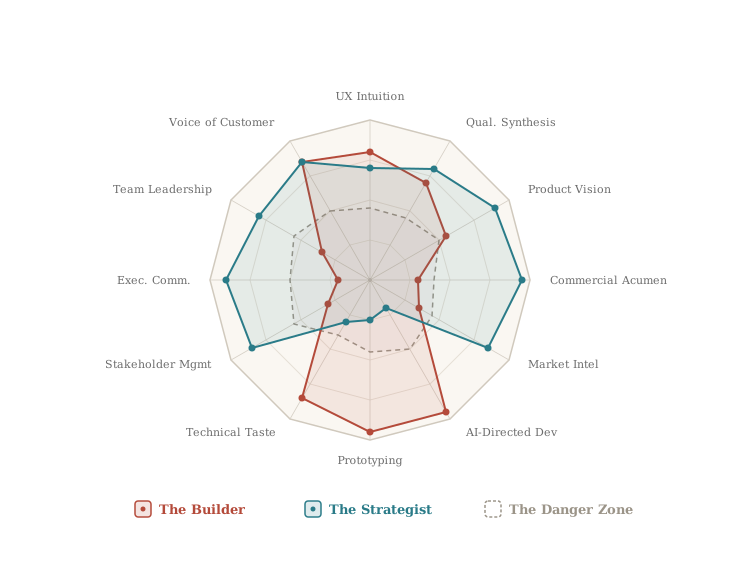
The Builder
High Technical Building. High Customer Closeness. Moderate Strategic Direction. Lower Organizational Influence.
This PM ships. They vibe-code prototypes, test hypotheses directly with customers, and iterate faster than any traditional team could. Most effective in early-stage products, zero-to-one environments, or anywhere the gap between idea and validation needs to be as small as possible.
The risk: Builders can create anything but may struggle to build the right thing at scale. Without Strategic Direction, they’re a productivity machine without a compass. Without Organizational Influence, their prototypes die on the vine because they can’t get buy-in.
The Strategist
High Strategic Direction. High Organizational Influence. High Customer Closeness. Lower Technical Building.
This PM owns the outcome. They understand the market, the customer, the competition, and the P&L. They make the high-stakes calls about what to build and what to kill. Most effective as a product team scales — when the coordination of what matters more than the speed of how.
The risk: Strategists can direct but can’t always verify. Without Technical Building, they can’t prototype or iterate independently, and they’re dependent on others to tell them whether what was built matches what was envisioned.
The Full-Stack PM
High across all four axes. This is the new unicorn.
This PM vibe-codes a prototype on Monday, tests it with customers on Tuesday, presents a strategic case to executives on Wednesday, and owns the P&L review on Thursday. They slide along the Builder-Strategist spectrum as the situation demands.
Reality check: Almost no one starts here. This is the shape you grow into over a career. Even peak PMs will have a home base on the spectrum. The value of this framework isn’t to make everyone a unicorn — it’s to know which direction you’re growing toward.
The Danger Zone
Moderate across all four axes. The old Coordination PM.
This PM used to be safe. They ran sprints, wrote tickets, managed stakeholders, and kept the trains running. They were the connective tissue of product teams. AI eats connective tissue.
If your primary value is coordination — translating between teams, managing timelines, writing status updates — you are in the most automatable position in product management. The Danger Zone isn’t about being bad at your job. It’s about your job being bad at surviving what’s coming.
The way out: Pick a direction. Lean into Technical Building and start shipping things yourself. Or lean into Strategic Direction and start owning commercial outcomes. The middle is shrinking. The edges are where value concentrates.
P&L: The Strategist’s Superpower
As PMs move toward the Strategist end of the spectrum, one competency emerges as the ultimate differentiator: P&L ownership.
AI can build features, run experiments, and even suggest what to ship next. It cannot own the commercial outcome. It cannot look at a product line’s margin structure and decide to kill a popular feature because it’s destroying unit economics. It cannot negotiate pricing, position against competitors, or make the call that this market is worth entering and that one isn’t.
Senior PMs who understand revenue, margins, and can tie product decisions to business results are the ones who become indispensable. This isn’t a skill AI is anywhere close to replacing — it’s a skill that becomes more valuable as everything around it gets automated.
The spectrum naturally leads here: Customer Closeness builds intuition about what customers value. Strategic Direction turns that intuition into commercial strategy. P&L ownership is the culmination. Companies that give senior PMs real P&L accountability will get better product decisions. Companies that keep PMs as feature factories — even AI-powered feature factories — will keep building the wrong things faster.
The Craft Question
There’s a sharp objection to this framework that I don’t want to dodge: if AI handles execution, where do junior PMs develop craft?
The concern is real. Dan Hockenmaier at Faire frames two archetypes emerging — “Insights” people with high judgment and “Builders” with great taste who ship products — while everything between compresses. Kim Faura reports the same pattern from CPO Track conversations. But the sharpest pushback from that community hits harder: “Agents taking over more doesn’t mean humans will automatically develop PM, Design, and Engineering competencies. Human competency development might become slower or weaker.”
If you never write a spec by hand, do you develop the judgment to know when an AI-generated spec is wrong? If you never run a sprint, do you understand why process structures exist?
The spectrum suggests an answer: junior PMs should start at the Builder end. Not because building is the destination, but because building is where you develop taste. You need to ship things, watch them break, see customers react, and iterate — all up close, not through layers of abstraction. The old junior PM path was: write tickets, coordinate sprints, gradually earn trust. The new path is: build things, test them with customers, develop judgment through direct feedback loops. You migrate toward Strategist as your judgment matures. You can’t skip the reps.
How to Use This Framework
I built this to be used, not just read. Here’s how.
For self-assessment. Plot yourself honestly on the four axes. Where are you strongest? Where are you weakest? More importantly — which direction are you moving? If you’re drifting toward the center, you’re drifting toward the Danger Zone.
For evaluating your team. Map each PM. Do your shapes complement each other? If you have three PMs who are all moderate across all axes, you have a coordination team that AI is about to compress. If you have a Builder and a Strategist, you have coverage. If you have a Builder who’s developing Strategic Direction, you might have a future unicorn.
For hiring. Stop hiring for “PM experience” measured in years. Hire for shape. Early-stage product? Hire a Builder. Scaling product line with P&L accountability? Hire a Strategist. And stop hiring Coordination PMs into senior roles. That shape worked in 2020. It doesn’t work in 2026.
For career development. Know your home base on the spectrum, then invest deliberately in stretching. Builders should take on strategic responsibilities — own a metric, present to executives, engage with pricing decisions. Strategists should build something — anything — to develop technical taste. Both should deepen Customer Closeness constantly, because proximity to the problem is the raw material for everything else.
The Shape Is Changing
Ravi Mehta built the best PM competency framework of the past decade. What I’ve outlined here isn’t a replacement — it’s an evolution, driven by the same forces that are reshaping product teams and redefining what’s automatable.
The old shape had twelve competencies across four balanced areas. The new shape has four axes weighted by a spectrum that every PM needs to navigate. The execution layer that defined half the PM role is being compressed by AI. What remains — Customer Closeness, Strategic Direction, Organizational Influence, and the entirely new axis of Technical Building — is more human, more valuable, and harder to fake than anything on the old chart.
Know your shape. Know your direction. The center is shrinking, and the edges are where the value is.